Palaces, Forts, Havelis and Heritage Hotels: Understanding India's Historic Places to Stay

Browse hotels in Rajasthan or other historic regions of India and you'll quickly notice the same words appearing over and over again: palace, fort, haveli and heritage hotel.
They aren't interchangeable.
Understanding what each one means makes it much easier to choose a stay that matches your interests, whether you're drawn to royal history, dramatic architecture or smaller properties with a strong sense of place.
A quick guide
Type of Stay | What It Means |
Palace | A building originally constructed as a royal residence, or in some cases, a modern hotel inspired by palace architecture. |
Fort | A defensive structure, often built on a hilltop or strategic location. Some forts also contained royal residences within their walls. |
Haveli | A traditional mansion, usually built by wealthy merchants or noble families around one or more courtyards. |
Heritage Hotel | A historic building adapted for hospitality. It may be a palace, fort, haveli, colonial bungalow or another significant historic property. |

Palace hotels
For many travelers, a palace stay is the highlight of a trip to Rajasthan. These buildings were originally built as royal residences, and many still preserve ceremonial halls, gardens, courtyards and architectural details that reflect their history. Some continue to have connections with former royal families. Others have been carefully restored as luxury hotels while maintaining the character of the original building.
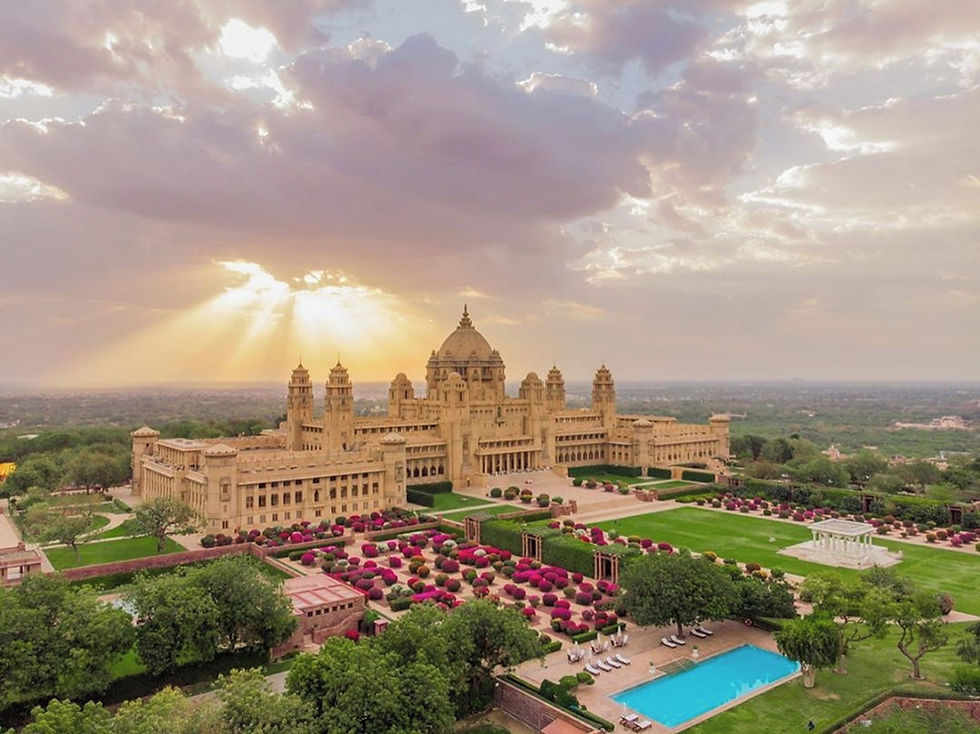
Rambagh Palace in Jaipur and Umaid Bhawan Palace in Jodhpur are among India's best-known examples of former royal residences that now welcome guests. Umaid Bhawan is particularly unusual because one section still serves as the residence of the former royal family, while the rest operates as both a luxury hotel and a museum.
Stepping outside of Rajasthan, properties like the Taj Falaknuma Palace in Hyderabad offer a completely different flavor of royalty, trading desert sandstone for European-style marble facades and sprawling hill-top views of the Deccan.
Not every palace-style hotel was once a palace. The Oberoi Udaivilas, for example, draws inspiration from Rajasthan's royal architecture but was purpose-built as a luxury hotel. Knowing that distinction helps you appreciate each property for what it is rather than assuming every grand building has the same history.

Fort hotels
Forts were built to protect kingdoms, trade routes and important cities. Many occupy spectacular hilltops or desert landscapes, and some grew into self-contained communities with palaces, temples and gardens inside their walls. Today, a handful have become remarkable places to stay.
Neemrana Fort-Palace, located between Delhi and Jaipur, is one of India's best-known examples. Exploring the property often feels like wandering through history, with terraces, stairways, courtyards and viewpoints revealing how the fort evolved over centuries. If you enjoy architecture and history as much as luxury, a fort hotel offers a very different atmosphere from a palace.

Havelis
If palaces belonged to royalty, havelis were generally the homes of wealthy merchants, landowners and noble families. Their scale is usually more intimate, with rooms arranged around central courtyards that encouraged natural light and ventilation. Intricately carved stonework, painted walls, wooden balconies and handcrafted details are common features.
Many have become boutique hotels, especially in Rajasthan. Samode Haveli in Jaipur is a well-known example, offering the character of a historic mansion with the comforts expected by modern travelers.
For couples or anyone who prefers smaller properties over large resorts, a haveli can be a particularly rewarding choice.

So what is a heritage hotel?
This is where the terminology often becomes confusing. A heritage hotel isn't one specific type of building. It's an umbrella term for a historic property that has been thoughtfully adapted for hospitality while preserving its architectural character. That property could be:
A palace.
A fort.
A haveli.
A colonial-era bungalow.
A former hunting lodge.
A historic estate.
In other words, every palace hotel may be considered a heritage hotel, but not every heritage hotel is a palace.
Which type should you choose?
The answer depends on what interests you most. If you've always wanted to experience India's royal heritage, a palace hotel is difficult to beat. If dramatic architecture and commanding landscapes appeal to you, consider a fort hotel. If you're looking for something quieter and more personal, a haveli often provides a more intimate stay. And if your priority is simply sleeping somewhere with genuine history, don't focus too much on the label. Many heritage hotels that aren't palaces receive some of the highest praise because of their character and hospitality.
Do you need to stay in one for your entire trip?
Probably not. One or two nights in a historic property is usually enough to appreciate the experience.
Many travelers enjoy mixing different styles of accommodation throughout their journey. You might choose a palace hotel while exploring Jaipur, a contemporary city hotel in Mumbai for convenience, and a backwaters property in Kerala for the final few days of your trip. Each serves a different purpose.
Look beyond the room
One of the pleasures of staying in a historic property is noticing details that modern hotels simply can't recreate. You may find hand-painted ceilings, carved jharokha balconies, marble courtyards, fountains, centuries-old gateways or gardens designed long before the building became a hotel. Many properties also organize heritage walks, traditional music performances, regional cooking experiences or talks on the history of the estate. If those are available during your stay, they're often well worth making time for.
A place with a story
Historic hotels are more than somewhere to spend the night. Whether you choose a palace, a fort, a haveli or another heritage property, you're staying in a building that reflects a different chapter of India's history. Understanding those differences before you book not only makes choosing a hotel easier, it also adds another layer of appreciation once you arrive.