Three Knots and a Wish: The Story Behind Bahia's Colorful Ribbons

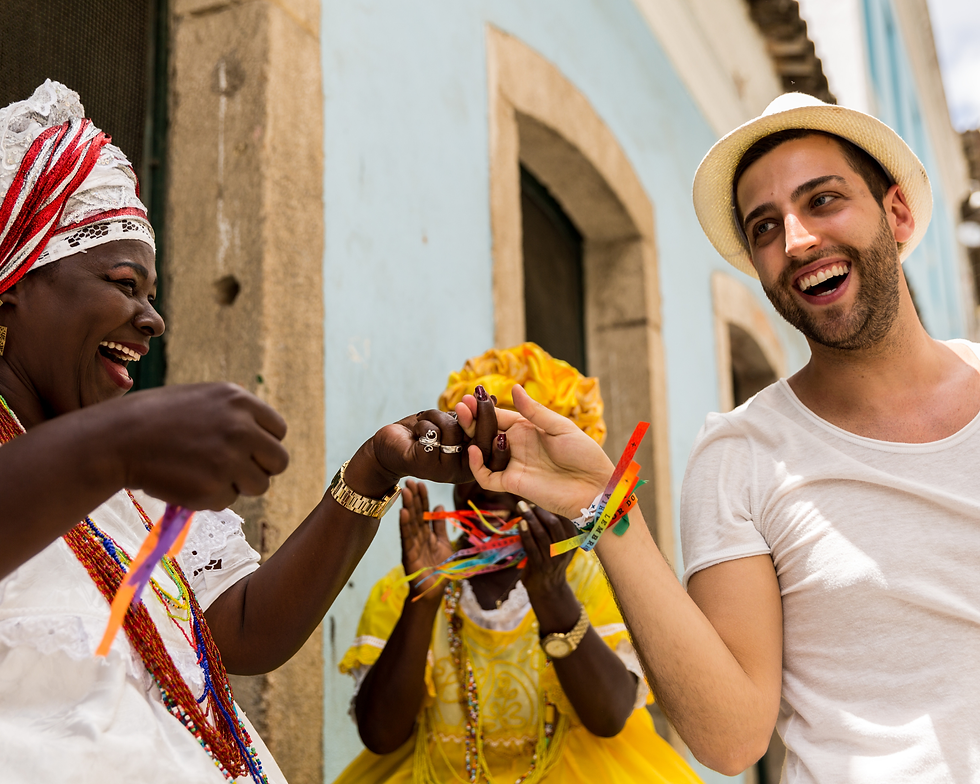
At a recent Brazilian event in Los Angeles, a woman dressed in traditional Bahian clothing tied a colorful ribbon around my wrist and explained a simple tradition: make three wishes, one for each knot.
The ribbon is called a Fita do Bonfim, and it is one of the most recognizable symbols of Bahia, a state in northeastern Brazil. Traditionally, the ribbon is tied with three knots, and a wish is made with each one. It is then worn until it naturally falls off. According to local tradition, when the ribbon breaks on its own, the wishes may come true.
Bahia.
To understand the ribbon, it helps to understand Bahia.
The state capital, Salvador, was Brazil's first colonial capital and remains one of the country's most culturally rich destinations. Bahia is known for its strong Afro-Brazilian heritage, shaped by centuries of African, Indigenous, and Portuguese influences. Music, food, religion, dance, and daily traditions all reflect this unique blend of cultures.
Visitors to Salvador often encounter these colorful ribbons tied to church gates, wrapped around wrists, hanging from bags, or sold by street vendors. The tradition is closely associated with the Church of Nosso Senhor do Bonfim, one of the city's most important religious landmarks.
Today, the ribbon serves different purposes for different people. Some wear it as an expression of faith. Others wear it as a symbol of hope, gratitude, protection, or connection to Bahia itself.

A Small Ritual With a Universal Meaning
Part of what makes the tradition so compelling is how familiar it feels, even to people who have never visited Brazil.
Around the world, cultures have created rituals that transform hopes and intentions into something tangible. In India, sacred threads are often tied around the wrist during religious ceremonies and festivals as symbols of blessing, protection, or connection. In Thailand, monks tie blessed strings around wrists during ceremonies. In Greece, many people wear a red-and-white bracelet called a Martis to welcome spring. In Japan, wishes are written on wooden plaques known as ema and left at shrines.
The details differ from place to place, but the idea is remarkably similar. People find ways to hold onto hope, mark important moments, and express wishes for the future.

More Than a Souvenir
For travelers, the ribbon may seem like a simple keepsake. In Bahia, it represents something deeper. It reflects a region where faith, tradition, community, and cultural identity remain visible in everyday life.
When the ribbon was tied around my wrist in Los Angeles, it created an immediate sense of familiarity. Perhaps it was because similar traditions exist in my own culture. Perhaps it was the simple act of someone sharing a meaningful custom and inviting me to participate. Or perhaps it was a reminder that even when cultures are separated by oceans and languages, people often express hope in surprisingly similar ways.
That small interaction sparked a curiosity about Bahia itself—a place where history, faith, music, and cultural traditions continue to shape everyday life. Sometimes a destination becomes interesting, simply because of a tradition that offers a glimpse into how people live, celebrate, and connect with one another.
To learn more about Brazil's destinations, culture, and travel experiences, visit Green Sea Shells' destination guides for Rio and the Amazon Rainforest.


