Designmuseum Danmark: What I Didn't Expect to Learn About Danish Design

There is a point somewhere inside Designmuseum Danmark when you may realize you have started paying an unreasonable amount of attention to chairs.

Not whether they are pretty or whether one would look good in your living room, but how the back curves, where the arms end, how much material has been used and why somebody decided that this was the right way for a human being to sit. Considering how little thought most of us give a chair until it is uncomfortable, there is something quite fascinating about seeing how much thought designers have given it.
That was not even what first pulled me into the museum. It was a display about the design process itself: early ideas, lines, circles, squares and draft after draft gradually working their way toward finished visual identities. Looking at the final logo, you would never know how many possibilities had been considered and discarded before someone arrived at something that suddenly looked obvious.
That process became a useful way to experience the rest of Designmuseum Danmark, because this is not really a museum where you need to know the names of famous Danish designers to enjoy yourself. It is much more interesting to start wondering why things around you have been designed the way they have. And once that happens, Copenhagen looks slightly different when you walk back outside.

Come for Danish Design, but Don't Assume You Know What That Means
Before visiting, Danish design can feel like one of those phrases everyone understands without actually having to define it. There will presumably be beautiful furniture, clean lines, excellent lamps and a considerable amount of pale wood.
All of that exists here, but Designmuseum Danmark is considerably less predictable.
The museum's permanent Danish Modern exhibition follows Danish design through the 20th century and into the present, which means the restrained furniture most associated with Denmark eventually gives way to rooms filled with bright plastics, futuristic forms, industrial steel and objects that seem to have missed the memo about Scandinavian minimalism entirely.
That is part of what makes the museum enjoyable as a traveler rather than simply educational as a design enthusiast. Every time you think you have figured out what “Danish design” looks like, another room complicates the answer.

The Chairs Are Famous, but the Search for the Right Chair Is More Interesting
There are, naturally, many chairs. Hans J. Wegner presented his now-famous Round Chair at this museum in 1949. American journalists later began referring to it simply as “The Chair,” and it became one of the objects associated internationally with Danish Modern.
What interested me more was learning how relentlessly Wegner kept returning to the problem. He developed hundreds of chair ideas over the course of his career, continually adjusting a piece of furniture humans had already been using for thousands of years.
It seems faintly ridiculous until you start looking at the chairs.
A chair needs to accommodate the body, remain strong without becoming unnecessarily heavy, feel comfortable and still work visually in the room around it. Change the angle of the back or the height of the arm and the experience changes with it.
Kaare Klint, another enormously influential Danish designer, believed designers should study successful furniture from the past rather than assume every generation needed to invent everything again. The museum describes this through his idea of a chair coming from a “good old family”: understand what has already worked, then adapt and refine it for contemporary life.
That idea appears repeatedly throughout the museum. Danish design starts feeling less like a quest to produce something nobody has ever seen and more like a very persistent attempt to make familiar things work better.

Copenhagen's Lamps Started Making More Sense
One of the displays I kept thinking about afterward was about light.
Copenhagen has no shortage of lamps. They hang low over restaurant tables, appear in hotel lobbies and cafés, and seem to receive considerably more attention than lighting often does elsewhere. Inside the museum, that begins to make sense in a very practical way.
Denmark spends a substantial part of the year with limited daylight, and the exhibition looks at the ways a lamp can control artificial light rather than simply provide it. Light can be directed onto a table, softened through a shade, spread through a room or concentrated around the people sitting beneath it.
This was also one of the few places where hygge stopped feeling like a word destined to be printed on candles and started making practical sense.
A comfortable room does not necessarily require more things. Sometimes the difference is simply where the light falls, how harsh it is and what part of the room it draws people toward. Later, back outside the museum, I started noticing the lamps in Copenhagen cafés.
That is when a museum visit becomes useful.

Then Danish Design Gets Very Loud
Just when you have settled comfortably into elegant furniture and beautifully controlled lighting, you enter the Pop section and Danish restraint appears to have taken the afternoon off!
The room is glorious. There are saturated reds, purples, blues and turquoise, sculptural furniture, shiny surfaces and forms that look more like a 1960s vision of the future than the neutral Scandinavian interior many visitors may have in mind.
Pop design arrived with youth culture, new synthetic materials, mass production, space-age optimism and psychedelia. Plastic and foam rubber opened possibilities that wood did not, and designers embraced them. A later High Tech section changes the visual language again, this time toward steel, glass and industrial materials.
Seeing these periods together is useful because it breaks one of the easiest assumptions to bring into the museum: that Danish design is a particular look.
It isn't quite that simple. The materials change. The colors change dramatically. Ideas arrive from elsewhere. What keeps resurfacing is the attention paid to how an object functions and how a person interacts with it.

The Japanese Sword Guards Were Not on My Danish Design Bingo Card
One of the biggest surprises was an extraordinary collection of Japanese tsuba, the hand guards positioned between the blade and handle of a sword. Hundreds of these small, often circular objects are displayed together, and even before knowing anything about them, the effect is beautiful. In one display, the repeated shapes create their own geometric pattern across the space.
The museum holds two significant tsuba collections. Its first director, Pietro Krohn, collected them before his death in 1905, while Danish doctor Hugo Halberstadt later assembled a collection of more than 1,700 sword fittings and donated it to the museum in 1940. Their presence initially seems unexpected in a museum associated so strongly with Danish design, but by this stage of the visit it begins to fit.
The museum repeatedly shows Danish designers studying objects and ideas that came before them and looking well beyond Denmark for inspiration. “Danish” design did not emerge inside a beautifully furnished Scandinavian bubble. That may be obvious once you think about it, but the museum makes the point visually rather than requiring you to take a course in design history.
Some of the Quietest Objects Explain the Most
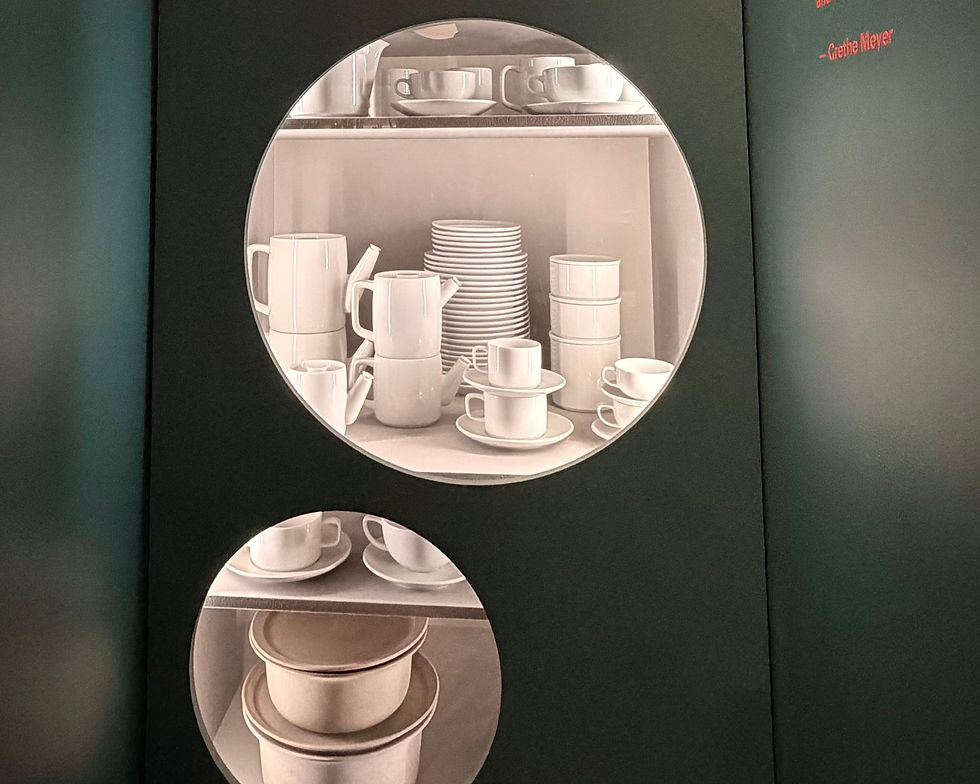
Near some of the more dramatic furniture are pieces of simple white tableware designed by Grethe Meyer. They would be very easy to walk past.
Meyer believed everyday objects should be straightforward, easy and pleasurable to use, while remaining as simple and anonymous as possible. Once you read that, the white cups, plates and serving pieces become much more interesting.
They stack. They fit together. There is little decoration demanding attention. They are objects designed to be used repeatedly rather than admired from a respectful distance. There is something to be said about confidently designing an object whose ultimate achievement is that nobody has to think very much about it.
It also brings the museum back to ordinary life. Design is not only the iconic chair someone saves for or the lamp whose designer's name everyone recognizes. It is the cup you pick up, the plate you eat from and the handle that feels right without your ever wondering why.
Don't Miss the Posters
The poster galleries extend that idea from objects into public life. The museum describes posters as “street pictures,” which is a useful way to look at them. These were not objects intended to sit unnoticed inside museums. They advertised products and cultural events, communicated political messages and, during wartime, conveyed information about scarcity and public behavior.
There are international influences here too, from Art Deco and European avant-garde movements to later American popular culture. It is another small dismantling of the idea that Danish design can be understood simply by looking at Danish furniture. Design is also what appears in front of you while you are walking down the street.

Then Walk Back Outside
This may be my favorite part of visiting Designmuseum Danmark.
You leave.
The museum sits on Bredgade, very close to Amalienborg Palace and Frederik's Church, so there is a good chance you will continue walking through central Copenhagen afterward.
And suddenly there are chairs everywhere - Not museum chairs, but restaurant chairs, café chairs and benches. Then there are the lamps hanging above tables, the glassware, shop signs, window displays, bicycles and the infrastructure created around them.
Not every attractive chair in Copenhagen is Danish and not every well-designed street corner represents some grand national design philosophy. But after spending a couple of hours looking at how much thought can go into the shape of a chair or the direction of a beam of light, it becomes difficult not to notice these things.
That was the real value of the museum for me. I did not leave wanting to memorize the names of Danish designers; I left paying more attention.

Planning Your Visit
Designmuseum Danmark is located at Bredgade 68, in a particularly convenient part of Copenhagen for sightseeing. Amalienborg Palace and Frederik's Church are nearby, and from here it is easy to continue toward Kastellet, the waterfront and the Little Mermaid.
The museum itself is housed in the former Royal Frederik's Hospital, built between 1752 and 1757 as Denmark's first public hospital. It moved into the complex in 1926 after architects Ivar Bentsen and Kaare Klint adapted the historic buildings for museum use, so it is worth paying attention to the surroundings as well as the collections. There is a central garden, and the museum café, shop and garden can be visited without buying museum admission.
Allow about 90 minutes to two hours for the museum. Follow what catches your attention: spend longer watching a visual identity develop through dozens of drafts, examine five chairs rather than fifty, or simply enjoy standing in that wonderfully excessive Pop room.
During our August 2026 visit, general adult admission was 140 DKK, visitors under 18 entered free, and reduced admission was available for students and visitors under 26. Admission is also included with the Copenhagen Card. Opening hours vary, so check the museum's current schedule before visiting.
If you already love design, putting Designmuseum Danmark on a Copenhagen itinerary is an easy decision. The more useful question is whether it deserves precious sightseeing time if you don't know Wegner from Klint and have never given much thought to the engineering of a dining chair. With a couple of days in Copenhagen, I think it does, precisely because the experience doesn't end at the museum door.
It gives you a way of looking at the city you are already visiting. You may walk in thinking Danish design means chairs, lamps and minimalism and walk out understanding that it is much harder to pin down than that. And for the rest of the day, you may notice what you are sitting on.