Why Is There So Much Rye Bread in Copenhagen? From the Netto Aisle to Smørrebrød

Updated: Aug 18
Walk into a Netto in Copenhagen looking for bread, and the rye section will stop you in your tracks.
There isn't just one dark Danish loaf waiting on the shelf. There are rows of them—some almost black, some visibly packed with kernels, others filled with sunflower seeds, with different percentages of rye and whole grain printed across packages that aren't particularly helpful if you don't speak Danish. At first glance, they look remarkably identical.

So which one are you supposed to buy?
That turns out to be a great entry point into Copenhagen, because rugbrød isn't simply another variety of bread. This dense Danish rye is an everyday staple—most famously serving as the structural foundation beneath Denmark's iconic open-faced sandwiches: smørrebrød.
To understand it, don't choose between the supermarket and the restaurant. Do both.
Navigating the Netto Aisle

At Netto, rugbrød isn't presented as high-concept culinary heritage. It is simply bread, taking up massive real estate on the shelves.
Unlike the soft, airy rye familiar to American supermarkets, traditional Danish rugbrød is dark, heavy, and packed with whole or cracked rye kernels and seeds. Sourdough starter gives it a subtle tang, but its defining feature is sheer weight. Pick up a loaf and there is real heft to it.
If you want to decode the packages, a few words make it easy:
Mørkt rugbrød: Dark rye bread (simpler, deeper malt flavor).
Solsikkerugbrød: Rye bread packed with sunflower seeds.
Kernerigt rugbrød: Whole-kernel rye, offering extra crunch and chew.
Fuldkorn: Whole grain percentage.
If you are staying somewhere with a kitchen, buy two contrasting loaves—a smooth dark rye and a heavily seeded version—and compare them. There is no single "definitive" Danish rugbrød, and that wall of choices at Netto is proof enough.
Rye became a staple in Denmark for a practical reason: it was well suited to the cool northern European climate and could grow in conditions where wheat was less reliable. For centuries, dense rye bread was everyday food for Danish farming households because the grain stored well, the bread was filling, and a loaf could last longer than softer wheat breads.
By the 1800s, rye bread was firmly established as a basic part of the Danish diet, and it later became the foundation of smørrebrød, the open-faced sandwiches that developed into one of Denmark’s best-known food traditions. That history helps explain why rugbrød still occupies so much supermarket shelf space today: in Denmark, rye bread isn't a specialty bread. It's everyday bread.
From the Shelf to the Table: Smørrebrød
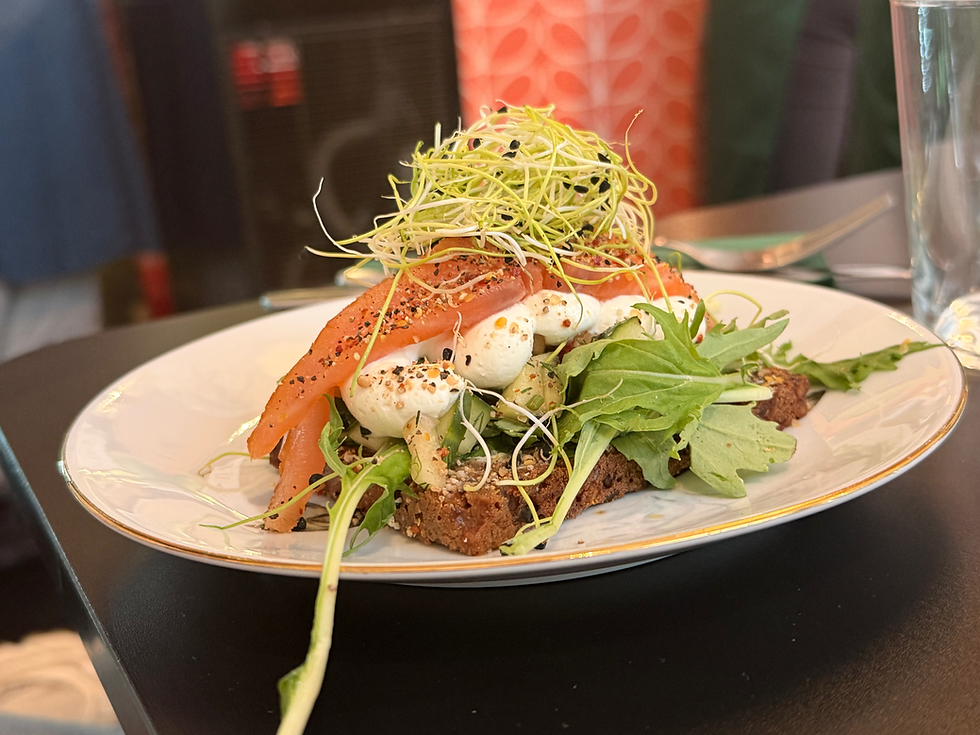
Eating rugbrød on its own tells you what the bread tastes like. Eating smørrebrød explains why it needs to be so heavy.
We tried ours at Iben's Smørrebrød on Store Kongensgade, a small restaurant within easy walking distance of Amalienborg Palace. Smørrebrød translates literally to "butter and bread," which is technically correct in much the same way that describing Copenhagen as "a city with bicycles" is technically correct!
The rye sits beneath carefully engineered layers of fish, meat, potatoes, vegetables, pickles, herbs, and sauces. Sometimes so much is happening on top that the bread underneath is barely visible.
Now its density makes sense. A softer bread would collapse into soggy ruin under all that weight. Rugbrød holds its ground, keeping its chewy texture and dark flavor intact in every bite.
What We Ordered (and the Vegetarian Reality)

There was one vegetarian option on the menu during our visit, which conveniently made the decision for me.
It was a classic potato smørrebrød built with tender potatoes on buttered rye, topped with smoked cheese cream (rygeost), green mayonnaise, pickled red onions, spring onions, radishes, and fresh sprouts. Potatoes on bread sounds like a serious commitment to carbohydrates, but it works brilliantly—the soft potatoes and cool creams are perfectly balanced by the sharp, acidic pickles and fresh crunch.
The rest of our table ordered the smoked salmon smørrebrød with crisp apple, cucumber, and smoked cheese cream, which was equally praised.
A word of caution for plant-based travelers: traditional smørrebrød relies heavily on seafood, cured meats, butter, and lard. Even vegetable toppings are often prepped with dairy or egg-based mayo. If you are strictly vegetarian or vegan, check current menus before making a special trip rather than assuming a dish can be modified on the fly.
Table Etiquette, Snaps, and Dessert

A few practical rules make lunch smoother:
Use a Knife and Fork: The word "sandwich" is a trap. Trying to lift a slice loaded with potatoes, cheese cream, and sprouts by hand is an unnecessary test of gravity.
Pace Yourself: The standard recommendation is two to three pieces per person. They look compact, but the dense rye and rich toppings make them remarkably filling.
Know the Snaps: If you see tiny, stemmed glasses arriving at neighboring tables, that’s snaps (aquavit)—a strong spirit flavored with caraway or dill. The ritual requires raising your glass, making direct eye contact across the table, and saying "Skål!"
Order the Berry Dessert: If rødgrød med fløde appears on a summer menu, order it. It’s a vibrant, chilled red-berry compote served with cold heavy cream. Attempting to pronounce it out loud is famously difficult for non-Danish speakers, but pointing at the menu is a perfectly valid backup plan.

Why the Grocery Store Matters
You could skip Netto and simply order smørrebrød at a great restaurant. But seeing rugbrød in the grocery store first changes the experience.
A restaurant shows you what skilled hands can build on top of the bread; the supermarket shows you how deeply ingrained it is in everyday Danish life.
By the time you walk back outside, those dark loaves at Netto aren't interchangeable anymore—and that heavy density finally has a clear, delicious purpose.


