Vasa Museum Stockholm: Inside Sweden’s Extraordinary 17th-Century Ship

There is something almost absurd about the Vasa story. Sweden built an enormous warship covered in hundreds of carvings, loaded it with 64 bronze cannons, and sent it out into Stockholm harbor to demonstrate the growing power of the Swedish kingdom. About 20 minutes later, it was underwater.
That happened in 1628.

The remarkable part is what happened 333 years later, when Sweden brought the ship back.
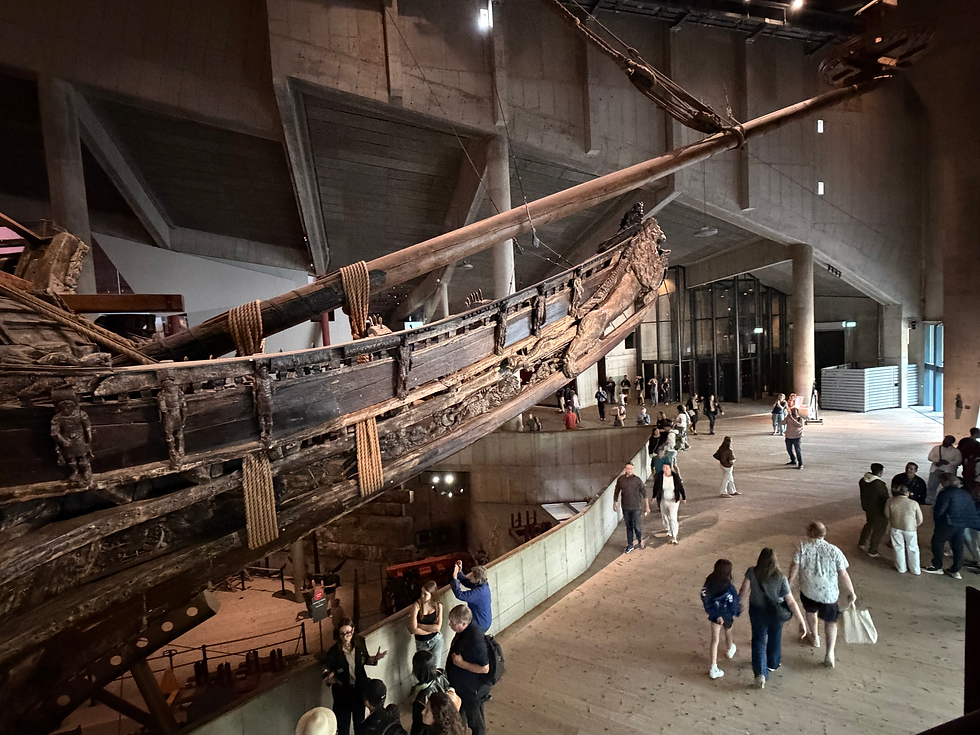
Today, you can walk into a museum on Djurgården and stand beside Vasa itself, remarkably intact after more than three centuries beneath the Baltic Sea. The museum was built around the vessel, with galleries rising beside it so you can look up at its towering hull from below, examine its elaborate carvings and gun ports at eye level, and look down across the decks from above.
This is where Vasa stops being just a story about an old shipwreck and becomes one of the most compelling experiences in Stockholm. You don't need to arrive knowing Swedish history, and you certainly don't need to be interested in naval museums. The pleasure here is in discovering Vasa piece by piece and realizing that almost everything you assume when you first see that giant vessel is only part of the story.
Is the Vasa Museum Worth Visiting?
Yes. The Vasa Museum is one of Stockholm's most distinctive attractions, built around the remarkably preserved 17th-century warship Vasa. Allow about 90 minutes to two hours to see the ship from multiple levels, explore its artifacts and reconstructed spaces, and understand why it sank on its maiden voyage.

Start by Walking Around the Ship
The ship dominates the Vasa Museum in Stockholm of course, and there is no reason to rush immediately into the surrounding side exhibitions. Spend some time simply taking in its scale.
From the lower level, the hull towers above you, reaching higher than a four-story building. As you move up through the galleries, the perspective shifts:
Lower levels: Highlight the sheer scale and massive structure of the oak hull.
Middle levels: Reveal intricate carvings, open gunports, and decorative details.
Upper levels: Give you a bird's-eye view across the main deck and lower sections of the surviving masts.
Each level explains a different aspect of the ship, which is why there isn't a single "best floor."
During our summer visit, people were scattered across every balcony—some leaning over railings taking photos, tour groups gathering at key viewpoints, and others reading the small illuminated displays. We had been warned that the museum could be overwhelming in peak season, but the building is so vast and the viewing areas so spread out that it never felt uncomfortably crowded.
Imagine All That Dark Wood Covered in Color
This is the moment when Vasa Museum becomes far more interesting than you might expect.
The ship standing in front of you today is a uniform dark brown—a natural result of centuries submerged underwater. But when you encounter the museum's reconstructed sculptures, you discover that the Vasa sailing out of Stockholm in 1628 looked radically different.
It was strikingly colorful.
Researchers examining microscopic paint traces identified vibrant shades of red, blue, green, yellow, and violet, along with detailed gold leafing. The museum has recreated several of the ship's figures using these exact historical pigments.
Go back and look at the ship again after seeing them.

Vasa carries over 500 sculptures and ornaments: lions, Roman emperors, biblical figures, and mythological beasts. They were not merely expensive decoration. Commissioned for King Gustav II Adolf during a period of rapid territorial expansion, the ship was designed as a floating piece of propaganda to communicate Swedish power before firing a single cannon. Its stern was essentially a giant piece of political storytelling in paint and wood.
The ship we see today is compelling because of its age and preservation. The ship that sailed in 1628 was designed to be a spectacle.

Looking for the Human Details
Once you have taken in the ship as a whole, another question emerges: How did anyone actually live in there?
Vasa was built to carry roughly 145 sailors and 300 soldiers. Look back at those decks with that number in mind.

To give you a sense of life onboard, the museum features full-scale reconstructions of specific spaces, including a section of the upper gun deck and the Great Cabin used by senior officers. You immediately feel the contrast between the relatively civilized quarters of the commanders and the cramped, dark working areas where everyday sailors lived crammed among heavy cannons.
Those small ports in the hull were not just for weaponry. Hundreds of men had to work, sleep, and eat in those exact spaces—which brings us to one of the most memorable objects in the collection.
Cooking Dinner for Hundreds of People
In the galley section, you will find an enormous cauldron that held about 215 liters (nearly 57 gallons).
Cooking meals for hundreds of people over an open fire inside a wooden ship was an immense hazard. To contain the heat and prevent a catastrophic fire, the galley base had to be lined with brick, sand, and clay.
Nearby displays showcase smaller remnants of daily life recovered from the mud:
Crew items: Simple wooden bowls, clay jugs, and bone combs.
Officer items: Pewter tableware, imported glass, and a bronze chafing dish used to keep food warm.
These everyday items lack the grand scale of the hull beside them, but they are what make Vasa feel human. The people who boarded in August 1628 were not stepping into a history lesson; they were simply going to work.
The World’s Oldest Surviving Sail

On one of the upper levels, displayed in a specialized light-controlled room, sits a large piece of aged fabric. It is one of Vasa's original sails.
The fore topgallant sail on display measures roughly 32 square meters—yet it was actually the smallest sail on the vessel. Six of Vasa's ten sails survived because they were stowed away when the ship sank. It is recognized as the oldest surviving sail in the world.
Once you have seen it, look back at the complex network of rigging surrounding the ship. Nearby displays explain how sailors maneuvered these massive canvas sheets high above the deck, transforming all those ropes and pulleys from visual clutter into a functional 17th-century engine.
How Did It Sink in 20 Minutes?

By now, the central question becomes unavoidable: How did a ship this elaborate founder almost immediately?
Vasa was heavily armed and beautifully built, but it had a fatal flaw: it was top-heavy and severely unstable. To accommodate a second gun deck ordered by the King, too much weight was placed high above the waterline relative to the narrow hull below.
On August 10, 1628, Vasa set out on its maiden voyage. Less than a mile into the trip, a light gust of wind caused the ship to heel over. Water poured in through the open lower gunports, and the great warship sank just 1,300 meters from shore. Around 30 people lost their lives within full view of the crowds gathered along the waterfront.
Raising and Preserving a Ghost Ship
Vasa sat in the cold, brackish waters of Stockholm harbor for 333 years. The low salinity of the Baltic Sea protected the oak timbers from wood-boring shipworms that normally destroy wooden wrecks.
After its rediscovery in 1956 by marine researcher Anders Franzén, a massive salvage effort began:
The Lift: Divers jetted tunnels beneath the hull to thread massive steel cables, allowing cranes to gradually lift the ship into shallower water before bringing it to the surface in 1961.
Polyethylene Glycol (PEG): To keep the waterlogged wood from shrinking and cracking as it dried, conservators spent 17 years continuously spraying the hull with PEG, a wax-like substance that replaced the water inside the wood cells.
Ongoing Preservation: The museum is deliberately kept cold and climate-controlled to prevent chemical deterioration.
A sophisticated new support structure is currently being engineered to replace the original 1960s cradle, ensuring the heavy timber hull does not sag under its own weight over time.
Hiding Nothing: The Modern Swedish Approach

Vasa was conceived as a grand symbol of power and royal ambition, but its maiden voyage ended in immediate embarrassment.
The modern Swedish achievement is not pretending otherwise.
Instead of burying the mistake, Sweden raised the ship, built a world-class facility around it, and turned a historic failure into an ongoing study of engineering, conservation, and archaeology. Researchers have analyzed everything from the health and diet of the crew to the chemical composition of the timber.
The King's ship was intended to show what Sweden could build. The museum shows what Sweden is willing to research, preserve, and understand. That makes for a far more compelling story.
Tips for Visiting the Vasa Museum

How Much Time to Spend:
Allow 90 minutes to 2 hours. This gives you enough time to explore the main decks, view the key artifacts, and watch one of the short background films without feeling overwhelmed.
What to Wear:
If you want to be cozy, bring a light sweater or jacket. The hall is kept cool year-round to preserve the wood.
Summer Crowds:
While summer is peak season, the multi-level layout naturally distributes crowds, making it easy to find good viewing spots even during busy hours.
Practical Details
Location: Galärvarvsvägen 14, Djurgården, Stockholm.
Hours: June–August, 8:30 AM–6 PM daily. September–May, 10 AM–5 PM daily, with extended Wednesday hours until 8 PM.
Admission: Adults 240 SEK May–September and 195 SEK October–April. Admission is free for visitors 18 and under.
How Long to Allow: Plan on about 90 minutes to 2 hours.
Getting There:
Tram: Line 7 to Nordiska museet/Vasamuseet.
Bus: Line 67 to Nordiska museet/Vasamuseet, or Lines 69/76 to Djurgårdsbron.
Ferry: Public SL Ferry Lines 80 or 82 to Allmänna gränd, followed by a short 5-minute walk along the water.

What You’ll Remember
You probably won't remember the exact date the ship sank. You will likely remember trying to fit the towering bow into a single camera frame, discovering that all that dark timber was once painted in bright red and gold, or looking through the open gunports to picture crew members cooking dinner in a massive copper kettle. Vasa began as a flawed attempt to project power. What stands on Djurgården today is something much better: a perfectly preserved window into the 17th century, kept alive by modern science in the very city where it was built.
Vasa Museum FAQ
Is the Vasa Museum worth visiting?
Yes. Even if you aren't particularly interested in ships or naval history, seeing an almost completely preserved 17th-century warship at full scale makes this one of Stockholm's most unusual museum experiences.
How long do you need at the Vasa Museum?
Allow around 90 minutes to two hours. That gives you time to see the ship from several levels, explore the major exhibits and watch the introductory film.
Why is the Vasa ship famous?
Vasa sank on its maiden voyage in Stockholm in 1628 after sailing for only about 20 minutes. It remained underwater for 333 years before being raised in 1961 and is exceptionally well preserved.
Where is the Vasa Museum?
The museum is on Djurgården in Stockholm at Galärvarvsvägen 14 and can be reached by tram, bus or ferry.


